A Beginner's Guide to Boating on the Gold Coast
By Freedom Boat Club Gold Coast · 8 min read · Updated November 2026
Thinking about getting out on the water but not sure where to start? Good news: the Gold Coast is one of the best places in Australia to learn. The Broadwater is sheltered, the weather is kind for much of the year, and help is never far away. This guide covers the rules every new skipper should know, using official information from Maritime Safety Queensland (MSQ) and the Queensland Government.
This article is general information only, current as of November 2026. Rules change, so always check the official sources linked throughout and at the end of this post.
1. Do you need a boat licence?
In Queensland, you need a recreational marine driver licence (RMDL) to operate a boat with an engine power greater than 4.5 kW, which covers almost every runabout, bowrider and cruiser. According to the Queensland Government:
You must be at least 16 years old and complete an approved BoatSafe course (or hold a recognised, valid interstate marine licence).
Your BoatSafe statement of competency is valid for six months, so apply for your licence within that window.
Once issued, a Queensland marine licence is valid for life and doesn't need renewing.
An unlicensed person can drive if a licensed supervisor is on board and able to take immediate control. Only a licensed driver can tow someone, such as a skier or tube rider.
The BoatSafe practical assessment covers slow-speed manoeuvres, berthing, a man-overboard drill, figure eights, emergency stops and judging a distance of 30 metres. That last one matters, as you'll see below.
2. Lifejackets: the rules changed in December 2024
Queensland's lifejacket laws changed on 1 December 2024. Under the current MSQ rules, wearing a lifejacket is compulsory:
for children over one and under 12 on an open boat, or in the open area of a boat of any length, while it's underway
when boating alone, or only with children under 12, in an open boat under 4.8 m that's underway
when boating between sunset and sunrise in an open boat under 4.8 m that's underway
for everyone crossing a designated coastal bar in an open boat, or in the open area of a boat of any length.
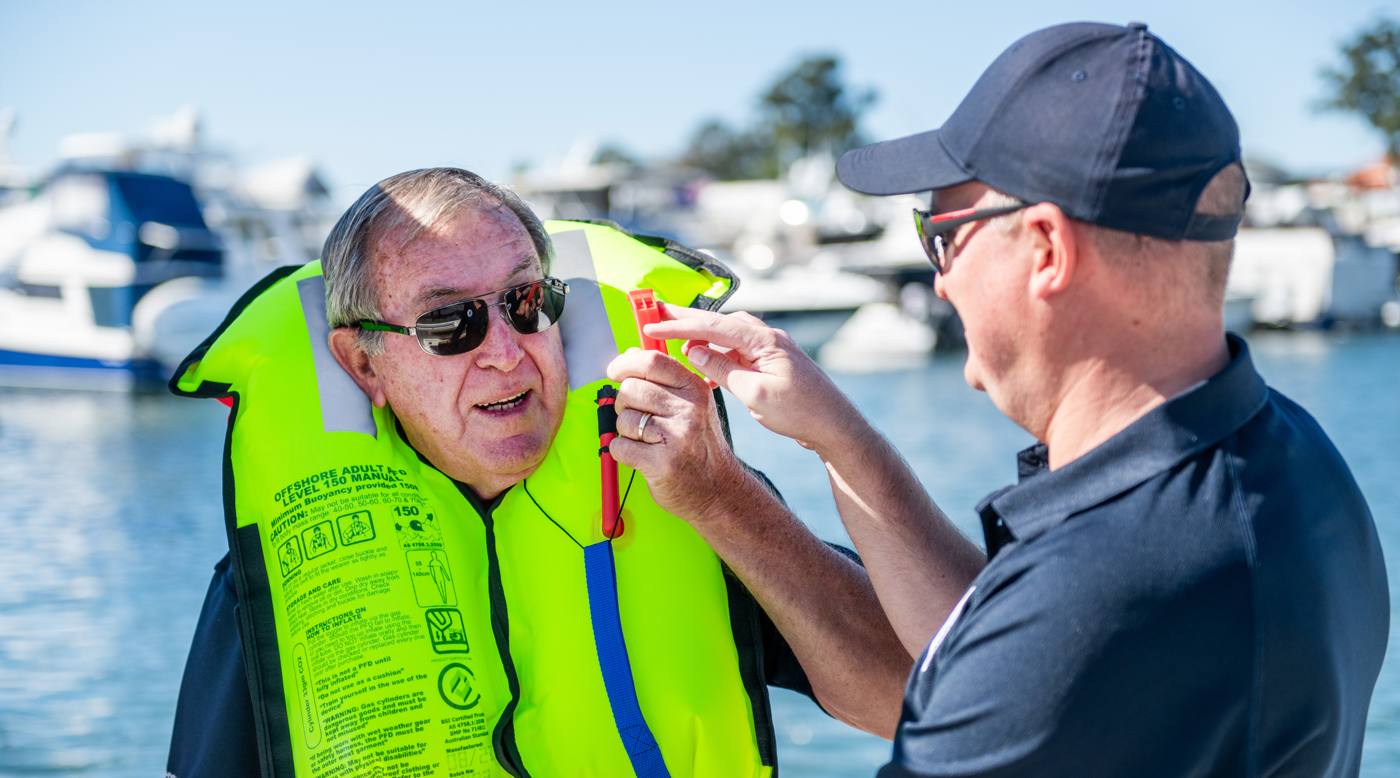
Since 1 September 2025, all lifejackets must meet the current Australian Standard AS 4758. Inflatable lifejackets must be serviced according to the manufacturer's instructions. Our advice is simple: put your lifejacket on before you leave the dock. MSQ points out it's almost impossible to put one on once you're in the water.
3. Carry the right safety equipment
The equipment you must carry depends on your boat and whether you're in smooth, partially smooth or open waters. MSQ defines these areas for each region, so check which applies to your route. For a registered boat, MSQ requires:
Smooth waters: a suitable lifejacket for each person, firefighting equipment, and a signalling device (like a torch) if operating between sunset and sunrise.
Partially smooth waters: all of the above (with the appropriate lifejacket level), plus two red hand-held flares, two orange smoke signals and a V-sheet.
MSQ also recommends an anchor, drinking water, bailing equipment and, in partially smooth waters, a chart and compass or a GPS. The skipper must tell everyone on board where the safety gear is kept. MSQ also strongly recommends wearing the engine kill-switch lanyard.
At Freedom Boat Club, every boat is fitted out and checked by our team before you step aboard. Your pre-departure briefing and safety check covers where everything is and how to use it.
4. Speed limits and the "30-metre rule"
This is the rule new skippers most often get wrong. Under MSQ's "distance-off" speed limits, boats must not go faster than 6 knots within 30 metres of:
a person in the water
a boat at anchor, moored, made fast to the shore or aground
a jetty, wharf, boat ramp or pontoon.
A 6-knot limit also applies in boat harbours, marinas and canals. These limits apply throughout Queensland whether there's a sign or not. On top of that, many Gold Coast waterways have fixed speed limits set by the Gold Coast Waterways Authority, shown on official signs and on the GCWA speed limit maps.
Six knots is roughly a brisk walking pace. Even at low speed your boat makes a wash, so look behind you and keep it down near beaches, pontoons and anchored boats. You're responsible for any damage your wash causes.
5. Alcohol: under 0.05 for the skipper
The skipper of a recreational boat must have a blood alcohol concentration under 0.05, the same as for most car drivers. There's zero tolerance for drugs. MSQ also notes that the skipper is responsible for passengers' safety and their alcohol consumption, and that sun, wind and motion can make alcohol hit harder (MSQ alcohol and drug rules). Save the celebratory drink for when you're back at the marina.
6. Respect the coastal bars
The Gold Coast has two designated coastal bars near the Broadwater: the Gold Coast Seaway Bar and the Jumpinpin Bar. MSQ warns that conditions on a bar "can change quickly and without warning, even on a good day". Freedom Boat Club boats stay inside the Broadwater – there are no offshore operations, and crossing the Seaway or the Jumpinpin Bar isn't permitted. There's plenty to explore from Amity Point in the north to the Nerang River in the south (MSQ coastal bar crossings).
7. Reading the water: channel markers and passing other boats
Australia uses the IALA "A" buoyage system. When you're heading upstream or into port, keep the red (port) markers on your left and the green (starboard) markers on your right. On the way out to sea, the reverse applies. Stick to the marked channels, because the Broadwater's sandbanks can be closer to the surface than they look, especially at low tide.
When you meet another powered boat head-on, both boats turn to starboard (right) and pass port-to-port. Keep a good lookout at all times. The Broadwater gets busy on weekends and holidays, with jet skis, sailing boats, kayaks and paddleboarders all sharing the water.
8. Check the weather, tides and tell someone your plans
Check the marine forecast and warnings from the Bureau of Meteorology before you go, and keep an eye on the sky.
Check tide times, especially if you're planning to beach the boat or explore shallow areas.
Tell someone where you're going and when you'll be back. Marine Rescue Queensland units also offer radio log-on services (MRQ safety information).
The easiest way to learn: unlimited training
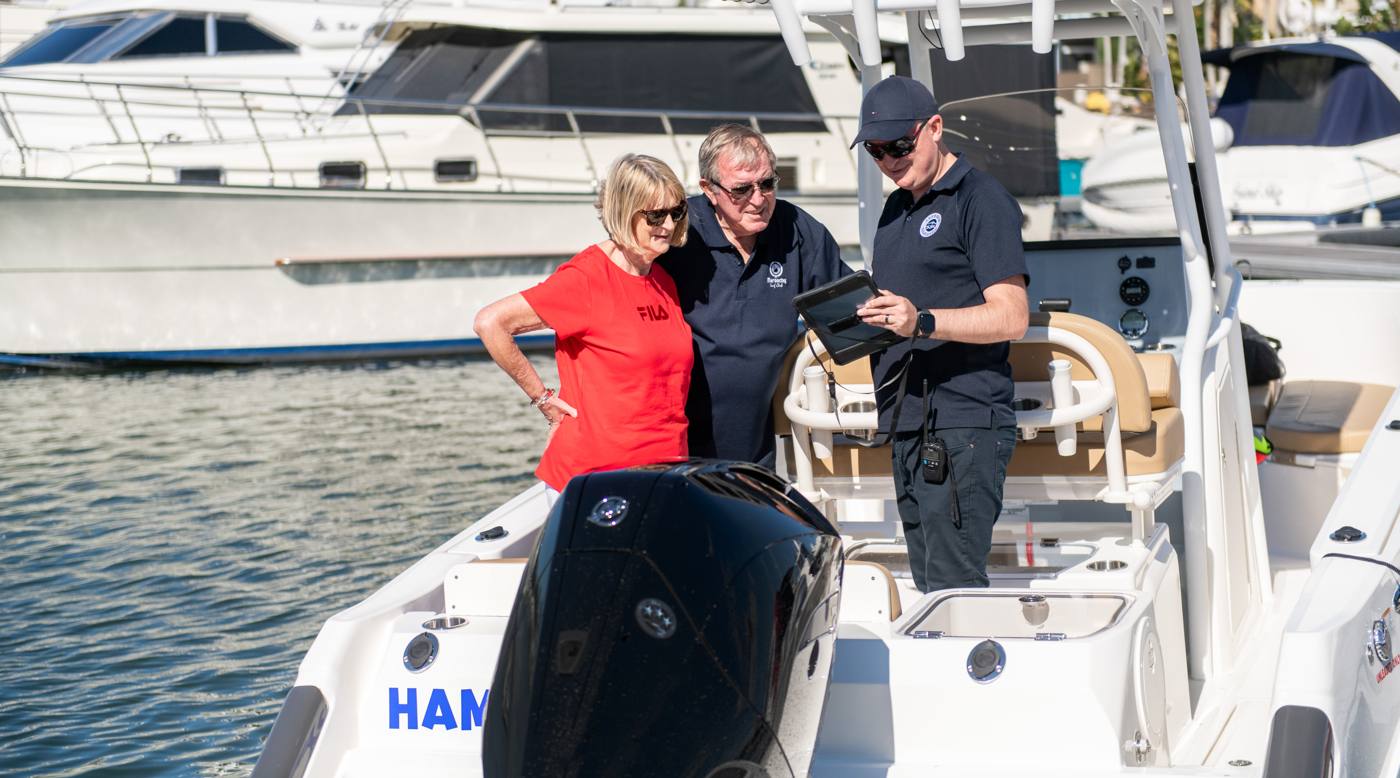
Rules are one thing. Confidence comes from time on the water with someone experienced beside you. That's why every Freedom Boat Club membership includes unlimited training from our team at Sanctuary Cove, whether you've never driven a boat before or you're returning after years away. We'll take you through docking, navigating the Broadwater, anchoring and local knowledge at your own pace, as many times as you need.
Sources:Queensland Government – Boat and personal watercraft licences; MSQ – Lifejackets; MSQ – Safety equipment for boats in Queensland; MSQ – Speed limits; GCWA – Speed limit map; MSQ – Alcohol and drug rules; MSQ – Coastal bar crossings; MSQ – Licensing; Marine Rescue Queensland – Safety information. Checked November 2026.
More Gold Coast boating
Come and see the fleet for yourself
Book a dockside tour at Sanctuary Cove. We'll show you the boats, walk you through how booking works and answer every question – no pressure.